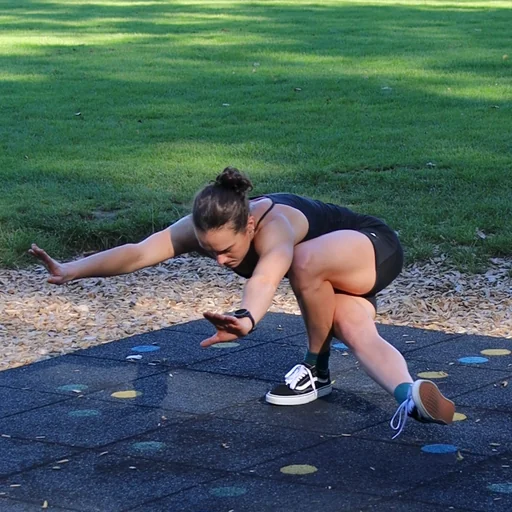
Long Lunges
Long lunges strengthen the legs and promote hip mobility. You take a large step forward, keeping the back leg straight and shifting your weight further forward. This variation particularly targets the leg and glute muscles while also improving hip flexibility, especially the mobility of the hip flexor. Additionally, the ankle joints are mobilized as the knee is pushed as far forward as possible over the toes. Unlike the classic lunge, the long lunge shifts the focus more forward, stretches the hip more intensively due to the extended back leg, and results in greater knee flexion.
Long Lunges - the correct execution
- Start in a long stride position with the left leg in front
- Push the left knee forward over the foot
- The right knee goes towards the floor
- Try to keep the right leg as straight as possible
- Keep the upper body upright
- Stretch both legs
- Work in the largest possible range of motion
Which muscles are trained by Long Lunges?


Primary trained muscles for Long Lunges
Adductors - The adductors are muscle groups in the thigh that help bring your legs together. They stabilize your pelvis while walking and standing and also assist in movements like crossing your legs.
Quadriceps - The quadriceps femoris is the large muscle at the front of your thigh. It extends your knee.
Glutes - The gluteus maximus is the large muscle in your buttocks. It is important for extending the hip, moving your leg backward, and stabilizing the hip joint.
Build stronger legs.
Want a leg workout without planning every session yourself? The DIE RINGE app chooses exercises for your level and equipment. Know what to train each session and keep track of your progress.
Train with DIE RINGEOver 1000 five-star reviews on App Store and Google Play.